
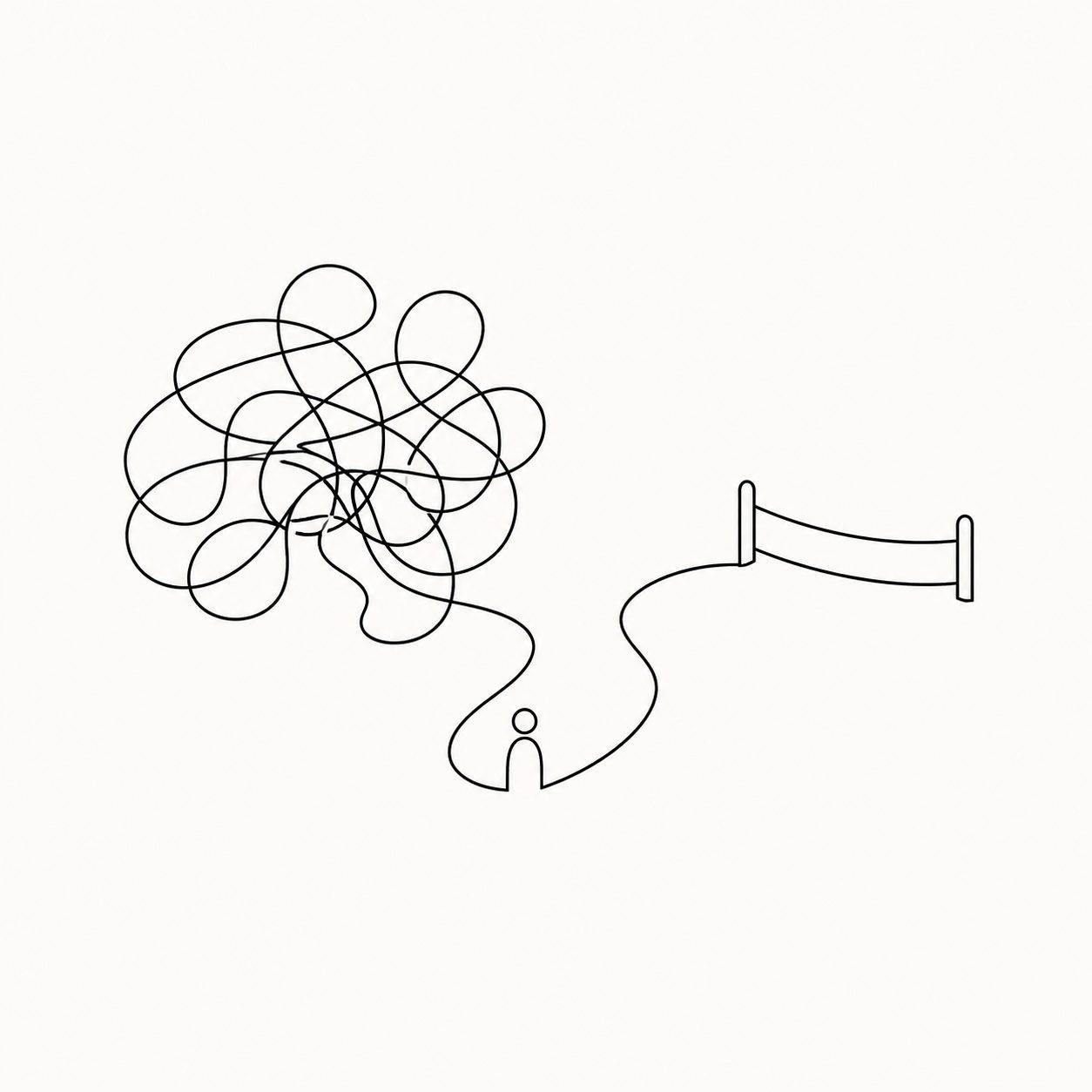
Procrastination and anxiety often reinforce each other. A task creates uncertainty or fear, delay provides immediate relief, and the unfinished task returns later with more pressure, guilt and consequences.
Key takeaways
- Anxiety can make a task feel threatening even when the practical action is simple.
- Delay reduces discomfort in the short term, which teaches the brain to use avoidance again.
- As deadlines approach, consequences and self-criticism increase anxiety and make starting harder.
- Small, specific actions and gradual exposure to discomfort can interrupt the loop.
How anxiety turns a task into a threat
The task may involve evaluation, uncertainty, conflict or the possibility of failure. Writing an email can mean risking rejection; opening a bill can mean confronting bad news; beginning an assignment can expose doubts about competence. The physical action is small, but the emotional meaning is large.
Anxiety narrows attention toward possible danger. The mind overestimates how bad starting will feel and underestimates its ability to cope. Waiting then appears protective.
Why avoidance feels effective at first
When you postpone the task, anxiety often drops immediately. That relief is powerful learning: the nervous system records that escape worked. The next time the task appears, avoidance becomes more automatic.
This is negative reinforcement. The behaviour is strengthened because it removes an unpleasant feeling. Unfortunately, it removes the feeling temporarily without resolving the task.
How procrastination creates more anxiety
Delay reduces preparation time, increases uncertainty and allows consequences to accumulate. The task may become objectively harder. Self-criticism adds another threat: instead of facing only the original task, you now face beliefs such as “I have ruined this” or “I can never trust myself.”
Research consistently links procrastination with negative emotions, including anxiety and stress. Chronic procrastination is also associated with higher stress and less healthy behaviour over time.
Is anxiety the cause of every procrastination problem?
No. Procrastination can also involve boredom, low reward, unclear instructions, fatigue, impulsivity, perfectionism or executive-function difficulties. The same person may delay different tasks for different reasons.
A useful question is: “What feeling or outcome am I trying not to experience by postponing this?” If the answer is embarrassment, uncertainty, conflict or failure, anxiety is probably part of the cycle.
Steps that weaken the avoidance loop
- Name the feared outcome: replace vague dread with a sentence such as “I am afraid the answer will be no.”
- Reduce the exposure: open the document, read the first line or draft without sending.
- Set a short contact period: stay with the task for five or ten minutes rather than demanding completion.
- Allow anxiety to be present: starting is not evidence that anxiety has disappeared; it is practice acting while it is manageable.
- Record what happened: compare the predicted catastrophe with the actual result.
These steps borrow from exposure principles: repeated, tolerable contact with the avoided situation can teach that discomfort is survivable and often temporary.
When to consider professional assessment
Seek support if anxiety is intense across many areas, if panic, compulsions or severe avoidance are present, or if procrastination is damaging education, work, finances or health. Therapy can address the anxiety process, while an assessment may identify ADHD, depression, sleep problems or another contributor.
Do not treat procrastination as proof of laziness. The more useful goal is to identify the function of delay and choose a response matched to that function.
Map your procrastination pattern
The MindLabIQ Procrastination Test helps organise patterns such as avoidance, emotional reactions and task delay. It cannot diagnose an anxiety disorder or ADHD.
Explore the Procrastination TestCommon questions
Can anxiety cause procrastination?
Yes. Fear of failure, evaluation, conflict or uncertainty can make avoidance feel safer in the short term.
Why do I feel calmer after deciding to do the task later?
Postponement removes immediate contact with the threat, so anxiety drops. That short-term relief reinforces the habit of avoiding.
Should I wait until I feel calm before starting?
Usually not. A small, manageable start while some anxiety is present can teach that action is possible without complete emotional certainty.
Sources and further reading
- Steel, P. (2007). The nature of procrastination: a meta-analytic and theoretical review.
- Nie, Y. et al. (2025). Procrastination and negative emotions: systematic review and meta-analysis.
- Pollack, S. & Herres, J. (2020). Negative affect and subsequent procrastination.
- Sirois, F. M. et al. (2023). Stress, health behaviours and procrastination over time.
Responsible-use notice
This article provides general educational information about procrastination and self-regulation. Persistent difficulty starting or completing tasks can have many causes, and an online questionnaire cannot diagnose ADHD, anxiety, depression or another condition.