
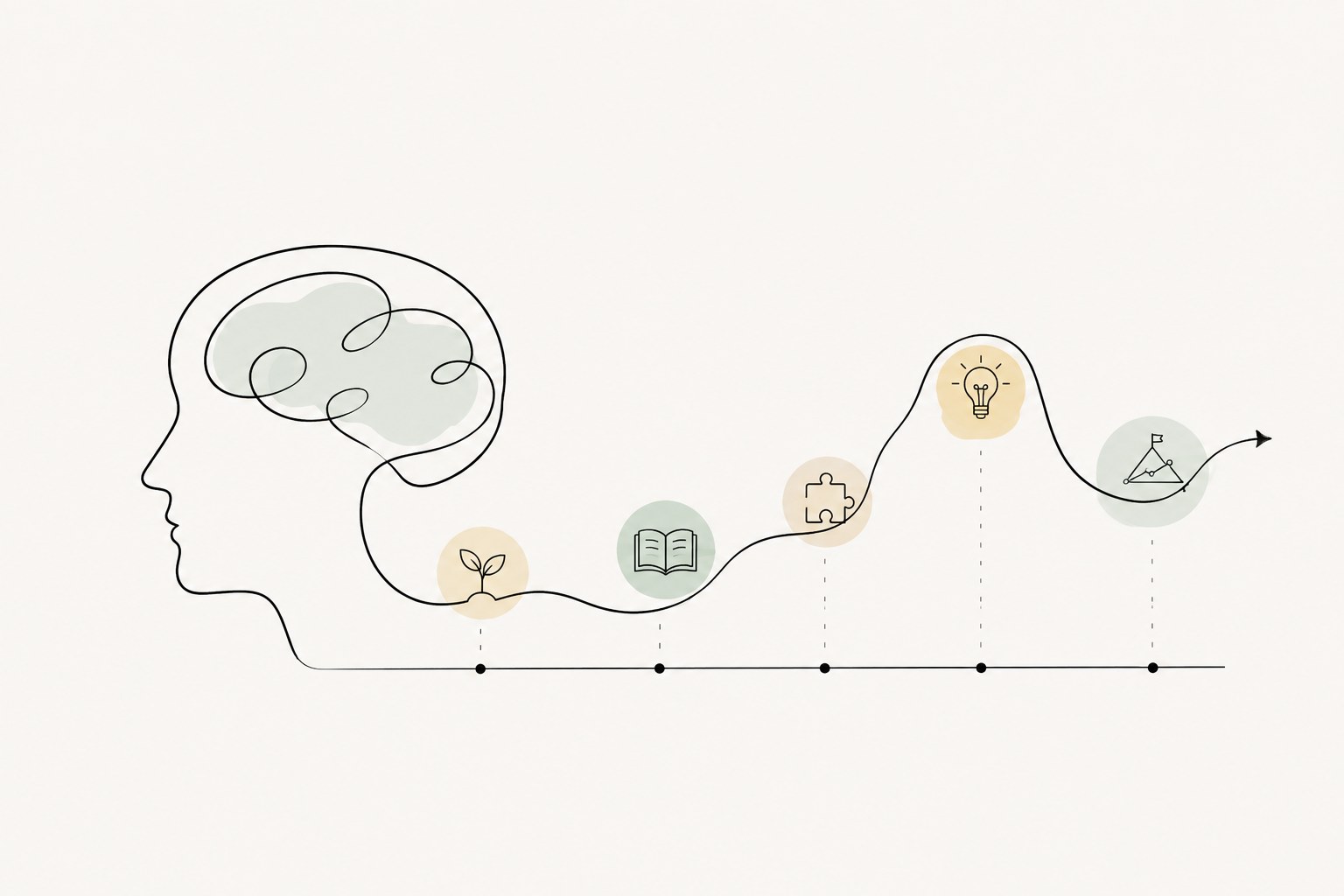
IQ is relatively stable, but “stable” does not mean frozen. A score can change because a person develops, learns, ages, becomes ill, practises similar tasks or simply takes the test under different conditions.
Key takeaways
- Rank-order stability generally increases from childhood into adulthood, but individual scores still vary.
- Education has measurable effects on cognitive performance, with meta-analytic evidence of gains associated with additional schooling.
- Retesting can raise scores through familiarity and strategy, especially when the same or similar items are used.
- A single score difference should be interpreted with measurement error, health and testing conditions in mind.
How stable is IQ?
Longitudinal research shows that cognitive abilities become increasingly stable as people move from childhood into adulthood. In practical terms, people who score relatively high compared with peers often remain relatively high later, but the exact number can move.
Stability is a group-level pattern. It does not mean every individual follows the same path. Development, education, illness and major environmental changes can influence performance.
Can education raise IQ?
A large meta-analysis of natural experiments found consistent evidence that additional education improves performance on intelligence tests. The estimated effect varied across methods, but the broad conclusion was that schooling does more than select people who already score well; it can contribute to cognitive development.
Education may strengthen knowledge, reasoning strategies, attention control and familiarity with abstract tasks. It does not transform every ability equally, and the effect of one extra year should not be treated as a guarantee for an individual.
How age changes cognitive abilities
Different abilities follow different trajectories. Knowledge and vocabulary may remain stable or grow through much of adulthood, while processing speed and some forms of fluid reasoning tend to decline earlier. Working memory and executive control can also change with age, health and lifestyle.
Modern tests use age-based norms, so an adult is compared with peers of a similar age. A stable standard score can therefore coexist with changes in raw performance.
Health, sleep and life circumstances
Sleep deprivation, pain, medication effects, acute illness, depression, neurological conditions and severe stress can influence attention and performance. Some effects are temporary; others may require medical assessment.
When a result changes unexpectedly, the first question should not be “Did my intelligence disappear?” but “Were the tests comparable, and what was happening around each session?”
Practice and retest effects
Repeated cognitive testing often produces practice effects. A person learns the format, becomes less anxious, recognises common item types and develops more efficient strategies. This can improve the score without representing an equally large change in broad cognitive ability.
Practice effects are strongest when the same material is repeated over a short interval. Alternate forms and longer gaps reduce, but do not always eliminate, the effect.
How to interpret a changed score
Compare confidence ranges, not only point scores. Small differences can be ordinary measurement variation. Larger changes deserve attention to test quality, age norms, language, environment, motivation and health.
Measure current reasoning performance
The MindLabIQ IQ Test provides an online estimate for education and self-reflection. It is not a clinical assessment or proof of permanent ability.
View the IQ TestCommon questions
Can brain-training apps permanently raise IQ?
Training usually improves the practised tasks most clearly. Evidence for broad transfer to general intelligence is more limited and mixed.
Does a lower score mean cognitive decline?
Not necessarily. Testing conditions and measurement error can explain differences. Persistent concerns about memory or functioning should be discussed with a health professional.
Can children’s IQ scores change more than adults’?
Yes. Developmental changes and differences in schooling can make childhood scores less stable than adult scores.
Sources and further reading
Responsible-use notice
Online IQ scores are estimates. Concerns about sudden or progressive cognitive changes should be discussed with a qualified health professional rather than evaluated through repeated online testing.