
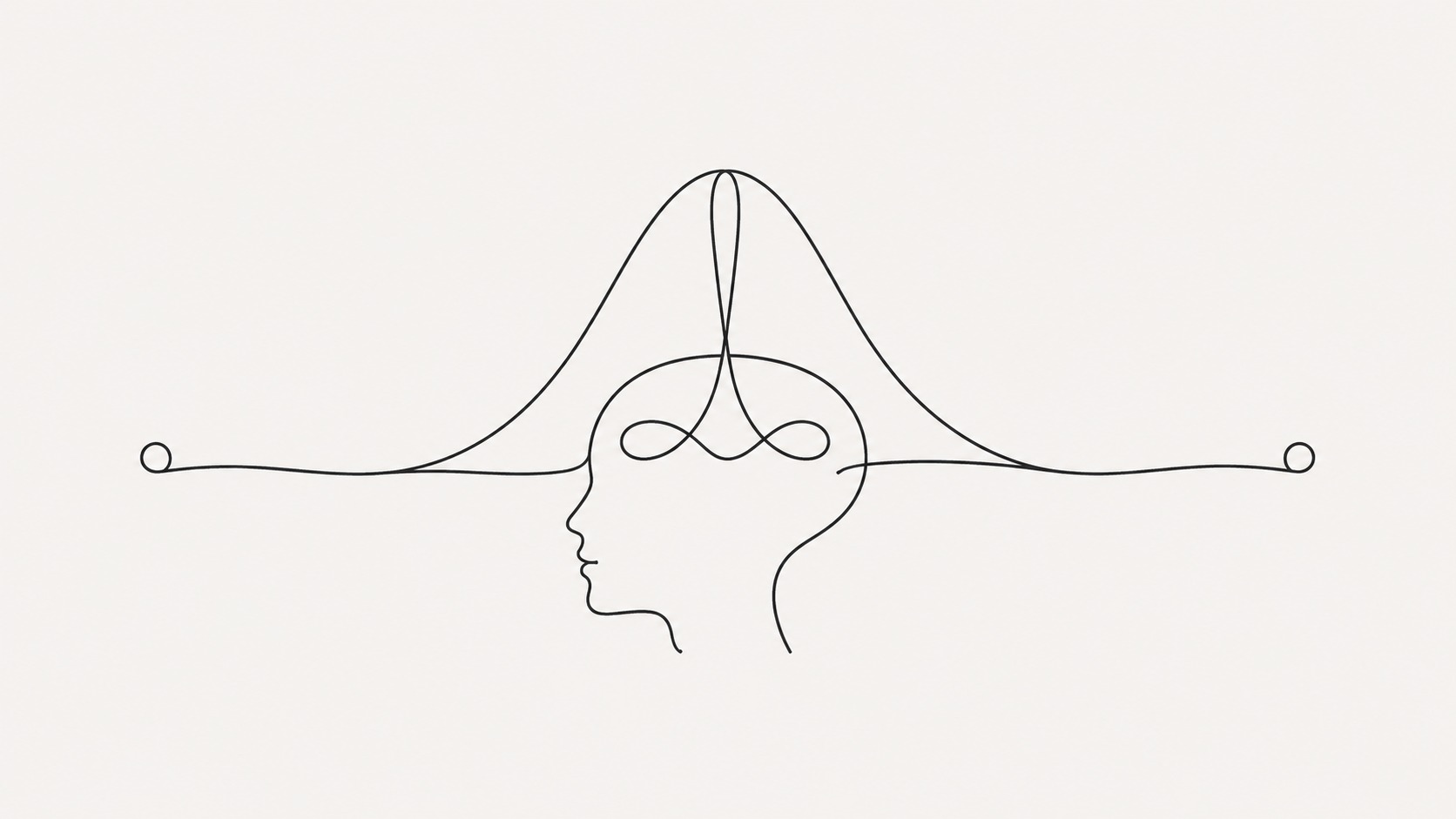
On most modern intelligence scales, the average IQ is defined as 100. That number is not a natural unit of intelligence. It is the centre of a standardised score distribution created from a norm sample.
Key takeaways
- The mean IQ is usually 100 and the standard deviation is commonly 15.
- About two-thirds of a normally distributed population falls between 85 and 115.
- A percentile describes the proportion of the norm group scoring at or below a result.
- Small score differences near the average rarely justify strong conclusions.
Why is the average IQ 100?
During standardisation, test developers collect results from a large comparison sample. Raw scores are transformed so the centre of that distribution becomes 100. Many current scales use a standard deviation of 15, which describes how widely scores spread around the mean.
An IQ of 100 therefore means that performance was close to the middle of the relevant norm group. It does not mean that a person answered exactly half the questions correctly, and it does not represent “100 units” of intelligence.
How IQ scores are distributed
IQ scales are designed to approximate a bell-shaped or normal distribution. Most results cluster near 100, while progressively fewer people fall at the extremes. With a mean of 100 and a standard deviation of 15, scores of 85 and 115 are one standard deviation below and above the mean.
The familiar “68–95 rule” is a useful approximation: about 68% of a normal distribution falls within one standard deviation of the mean, and about 95% falls within two. Real norm samples are not perfectly smooth curves, so these figures should be treated as approximations.
Common IQ score ranges
| IQ range | Approximate position | Interpretive note |
|---|---|---|
| Below 70 | Lowest roughly 2–3% | Requires careful professional interpretation; an IQ score alone does not establish a diagnosis |
| 70–84 | Below the broad average range | Some abstract or highly time-pressured tasks may require more support |
| 85–115 | Middle roughly 68% | Often called the broad average range |
| 116–129 | Above the broad average range | Suggests comparatively strong performance on the sampled reasoning tasks |
| 130 and above | Highest roughly 2–3% | Uncommon performance; interpretation still depends on the test and conditions |
Publishers use different descriptive labels and cut-offs. The score itself is continuous, so a person at 114 is not fundamentally different from a person at 116. Categories are communication aids, not natural boundaries between types of people.
IQ scores and percentiles
A percentile can be easier to understand than a standard score. An IQ near 100 corresponds to roughly the 50th percentile. A score of 115 is around the 84th percentile, while 130 is around the 98th percentile under the usual normal-distribution model.
Percentile rank is not the percentage of questions answered correctly. It describes relative standing. Being at the 84th percentile means the result was as high as or higher than approximately 84% of the comparison group.
Compare your reasoning performance
The MindLabIQ assessment provides an educational estimate aligned to the familiar IQ scale. It is intended for self-reflection rather than formal diagnosis or certification.
View the IQ assessmentIs an IQ of 100 good?
Yes. A score of 100 is exactly at the statistical centre of the scale. It indicates typical performance for the reference group on the tasks included in that assessment.
In everyday life, people throughout the average range successfully complete education, learn complex work routines, create art, run businesses and maintain demanding relationships. IQ is related to some kinds of learning and problem-solving, but it is not a ranking of human value or a complete prediction of achievement.
Why context matters
Age, language, education, health, disability, testing conditions and familiarity with similar tasks can all affect performance. Norms also age. Professional publishers periodically update tests so the comparison group better reflects the current population.
When interpreting an individual score, consider the confidence interval and the pattern across tasks. A person may have a broad average overall result with a pronounced strength in one domain and a weakness in another.
Common questions
What IQ score is considered average?
Many reports use 85–115 as the broad average range because it covers approximately one standard deviation on either side of the mean.
Is 110 meaningfully better than 105?
Not necessarily. Small differences can fall within ordinary measurement error and should not be overinterpreted.
Does the average IQ change over time?
Raw test performance can shift across generations. Test publishers renorm scales so the standard score average remains 100 for the new reference sample.
Sources and further reading
Responsible-use notice
IQ ranges and percentiles in this article are approximate and depend on the scale, norm sample and administration. MindLabIQ results are educational estimates and are not formal psychological evaluations.